
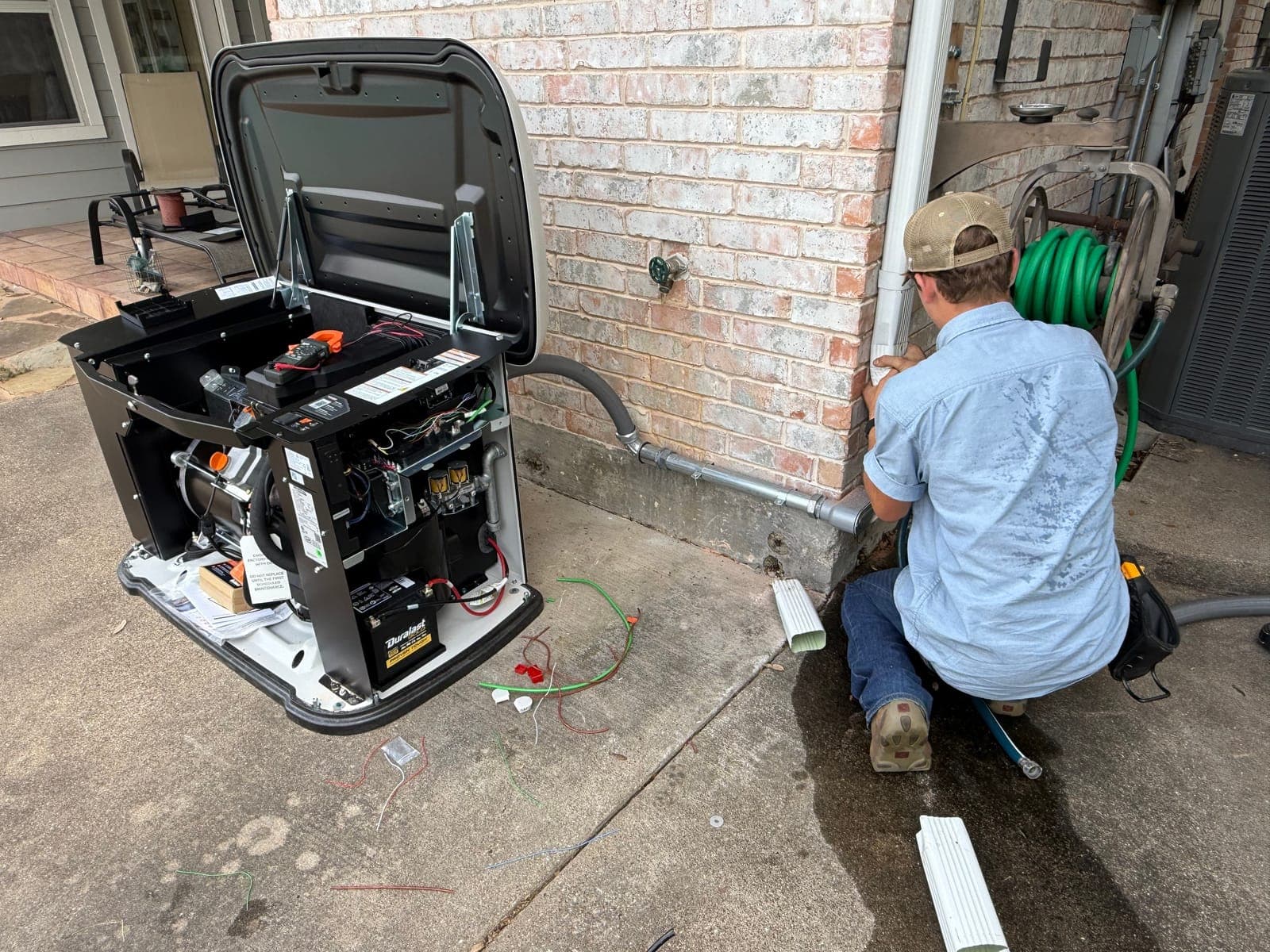
A standby generator only earns its place when it starts the moment the grid drops. That takes scheduled service, and there are two ways to pay for it. You can enroll in a maintenance plan, or you can call for service visit by visit. Both get the work done. The difference is who keeps track of the schedule, how quickly you get on the calendar, and what happens when a problem turns up.
The short answer
For most homeowners in Parker, Palo Pinto, Erath and Tarrant counties, a maintenance plan is the simpler choice. It puts the service schedule on us and moves you up the list after a storm. Pay-per-visit service can work if your generator rarely runs, you keep your own records, and you don't mind waiting your turn when everyone calls at once.
What both options have in common
Every manufacturer expects regular professional service, whether you're on a plan or not. Kohler's own guidance says most standby generators should receive professional service at least once per year, even when the unit has barely run. Heavier use changes that. Kohler also notes that long outages, severe weather and dusty conditions can call for more frequent visits.
The visit itself is the same either way. Our generator maintenance service follows a 45-point inspection that covers the controller and telemetry, the starting system, engine and fluids, fuel delivery, electrical output, the transfer switch, and the enclosure and site. If you want to see what each step involves, our home standby generator maintenance checklist walks through it.
How a maintenance plan works
Our generator maintenance plans come in three tiers, Shield, Armored and Fortress. Each one is available on an annual schedule (one visit a year) or a bi-annual schedule (two visits a year).
- Shield covers a multi-point factory inspection, battery and telemetry diagnostics, a fluid and pressure check with a run test, and reminder scheduling. Consumables like oil, filters and spark plugs are billed when they're due.
- Armored adds priority scheduling for service calls, reduced diagnostic and service-call rates, a mid-year check-in by phone or text, air filter, spark plug and oil service when due, battery replacement at intervals set out in the plan terms, and a member discount on repairs and upgrades.
- Fortress adds monthly remote system monitoring, a faster response goal, and full labor and materials on routine filter, plug and oil service.
Every new generator we install comes with the Shield plan for its first year. You can move between tiers, or between annual and bi-annual schedules, with a call to the office.
Plans are preventive. They keep the generator ready, but repairs after a failure are quoted separately. If a visit turns up a problem, we document it, explain it and give you a written estimate, and nothing beyond the plan's scope is done without your approval.
How pay-per-visit service works
After the first year, a plan is optional. You can call us when service is due and we'll carry out the same inspection, with on-site readings, component photos and a written estimate for anything that needs attention.
If we didn't install your generator, the first visit is a full diagnostic rather than a routine service. That gives us a baseline for a unit we haven't seen before.
The trade-offs are practical ones:
- You keep track of service dates and run hours yourself
- You book like any other caller, without priority on the calendar
- After a major outage, when every generator owner in the area is calling, you may wait longer for a slot
Which one fits your home
A plan usually makes sense if:
- You'd rather not track run hours and service dates on your own
- Your household depends on backup power for a well pump, medical equipment or livestock water
- Your power drops often, or the generator sits in rural dust, where two visits a year are worth having
- You want to be near the front of the line after a storm
Pay-per-visit can make sense if:
- Your generator rarely runs beyond its weekly self-test
- You already keep a reliable service log
- You prefer to approve and book each visit yourself
What to do after a long outage
Extended running uses up service life faster than a normal year of self-tests. Generac's advice for owners is to compare run hours since the last service against the maintenance schedule, and if you're unsure, it says "it is best to perform an oil and oil filter change."
On a plan with monitoring, we track this for you. On pay-per-visit, check the run hours on your controller or app after a long outage and call us if service is due.
Why records matter for your warranty
Manufacturers expect documented, scheduled service to keep factory coverage intact. When a warranty claim comes up, the service record is the first thing anyone asks for. A plan keeps every visit, reading and photo in one place. If you go visit by visit, keep those records yourself. Our post on how to keep a Generac or Kohler warranty valid covers what manufacturers look for.
Who should service your generator
A standby generator ties into your home's electrical system and its fuel supply, so the person servicing it should be qualified for both. In Texas, electrical work is licensed through the Texas Department of Licensing and Regulation.
Armored Power Systems works under Master Electrician oversight with Texas Electrical Contractor License TECL #41587, and we're a Generac Authorized Sales and Service Dealer (#1033043). We service Generac, Kohler and Rehlko, Briggs & Stratton, Cummins, Champion and Honeywell units, including ones we didn't install.
Talk to Armored Power Systems
Not sure which option fits your generator? We'll look at how often it runs, how your home uses it and what records you already have, then help you choose.
- Call or text: (817) 381-6158
- Email: info@armoredpowersystems.com