
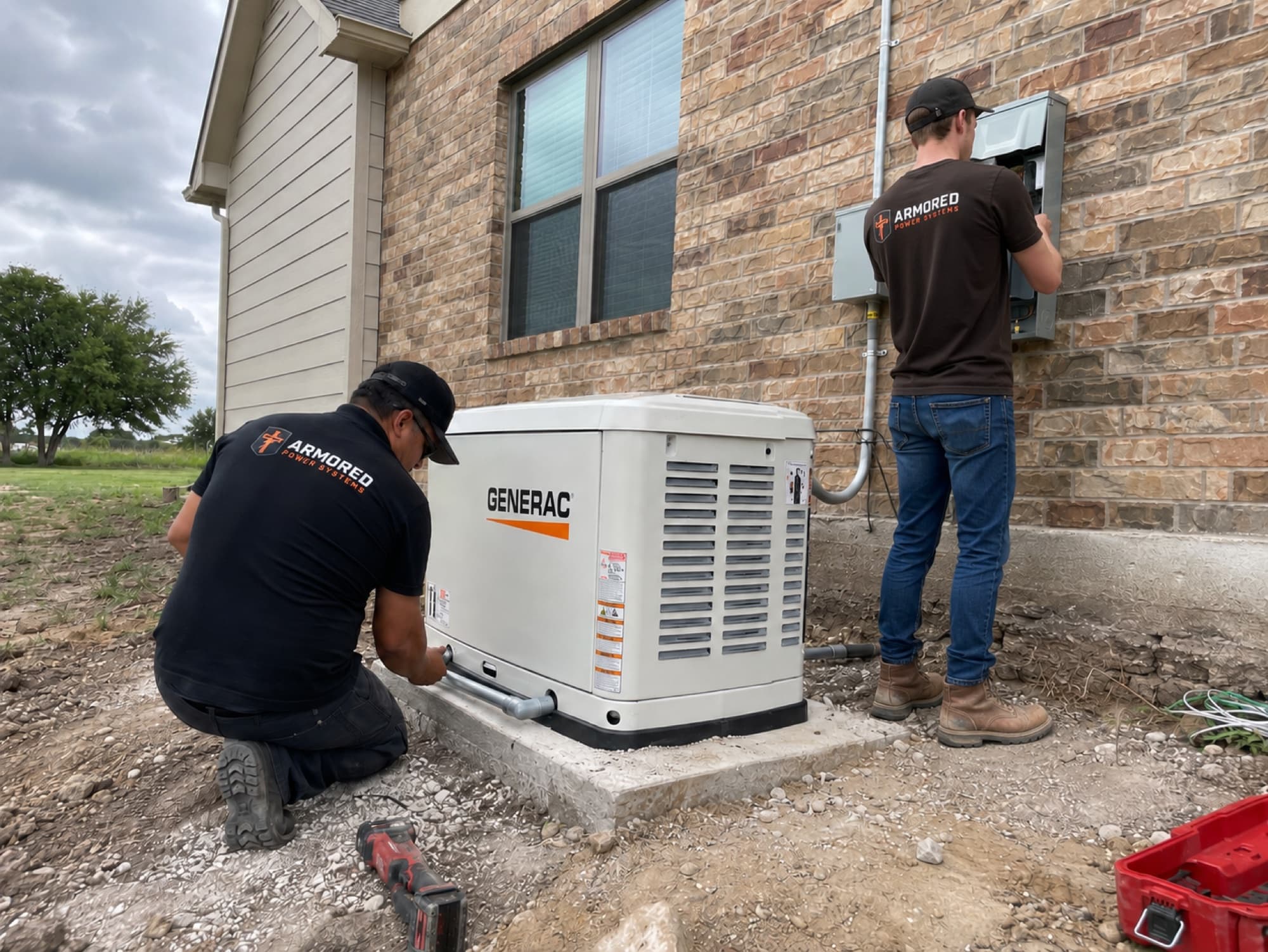
Sooner or later, every standby generator owner gets the call or the alarm that something is wrong. When the unit is young and under warranty, the answer is usually simple. When it has some years on it, the question becomes harder: is this a repair worth making, or is it time to replace the generator? There is no single age at which the answer flips. It depends on what failed, how the unit has been looked after, and whether it still fits the way the house is used today.
These are the factors we weigh before recommending either path.
What actually failed
The single biggest factor is the nature of the failure. Many generator problems involve parts that are designed to be serviced or replaced over the life of the unit: the starting battery, a voltage regulator, a set of contacts, a sensor or a control board. Those repairs restore the generator to good working order, and on a unit that is otherwise sound, they are almost always worth making.
Major mechanical failures are a different conversation. A failed alternator or serious internal engine damage on an older unit can cost a substantial share of what a new generator would, and the rest of the machine is still the same age. That is when we lay out both options side by side.
How the generator has been maintained
A generator with a documented service history is a much better candidate for repair than one that has been ignored. Kohler's guidance on how often to service a home generator lists increased engine wear and reduced lifespan among the consequences of skipping maintenance. When we open a unit that has had regular oil changes, filters and battery checks, we are far more confident that fixing the failed part will give you reliable service afterward.
If the maintenance history is unknown, a full inspection comes first. Kohler's service and maintenance overview notes that advanced service options such as load bank testing may be recommended, and on an older unit, testing it under a real load is one of the best ways to find out whether it can still do its job.
Where the warranty stands
Check whether any part of the factory warranty or an extended warranty is still in effect before paying for a repair. Generac's own support guidance on warranty transfers explains that a home standby warranty can transfer between owners at the original installation site, but it cannot be transferred from one generator unit to another. That matters if you bought the home with the generator in place, and it matters when you weigh a replacement, because a new unit starts a new warranty of its own.
You can look up a Generac unit's registration through Generac owner support, or ask your dealer to check it for either brand.
Whether the generator still fits the house
Houses change. Since the generator was installed, you may have added a second air conditioner, a pool, a shop, a well pump, an EV charger or a home office that cannot go dark. A generator that was correctly sized years ago may now be undersized, running near its limit every time it carries the house.
Repairing an undersized generator restores it to the same undersized state. If the loads have grown, we recalculate them, and our generator sizing page explains how. Sometimes load management solves the gap without replacing the unit. Sometimes it is the moment to move to a generator that fits the house as it is today.
Parts and support for the model
Ask whoever services the generator whether parts for your model are still readily available and whether the manufacturer still supports its control system. A repair that depends on hard-to-find parts can leave you waiting during exactly the season you need the unit most. This varies widely by brand and model, so it is a question for a dealer authorized for your equipment rather than a general rule.
Putting it together
As a rough way to think about it, repair usually makes sense when:
- The failed part is a serviceable component rather than the engine or alternator.
- The generator has a reasonable maintenance history.
- It is still the right size for the house.
Replacement deserves a serious look when:
- The failure is major and the rest of the unit is aging too.
- The service history is unknown or poor and testing turns up more problems.
- The house has outgrown the generator.
Whichever way it goes, we give you the diagnosis and both numbers in writing, and we do not pretend a repair is a bargain when it is not. Our generator repair page explains how a diagnostic call works. If replacement is the better path, our standby generator installation page covers what a new install involves, and a maintenance plan keeps either one ready for the next outage.
Talk to Armored Power Systems
Generator acting up and not sure whether it is worth fixing? Give us the brand, the model and what it is doing, and we will help you decide with real information.
Call (817) 381-6158 or email info@armoredpowersystems.com.