
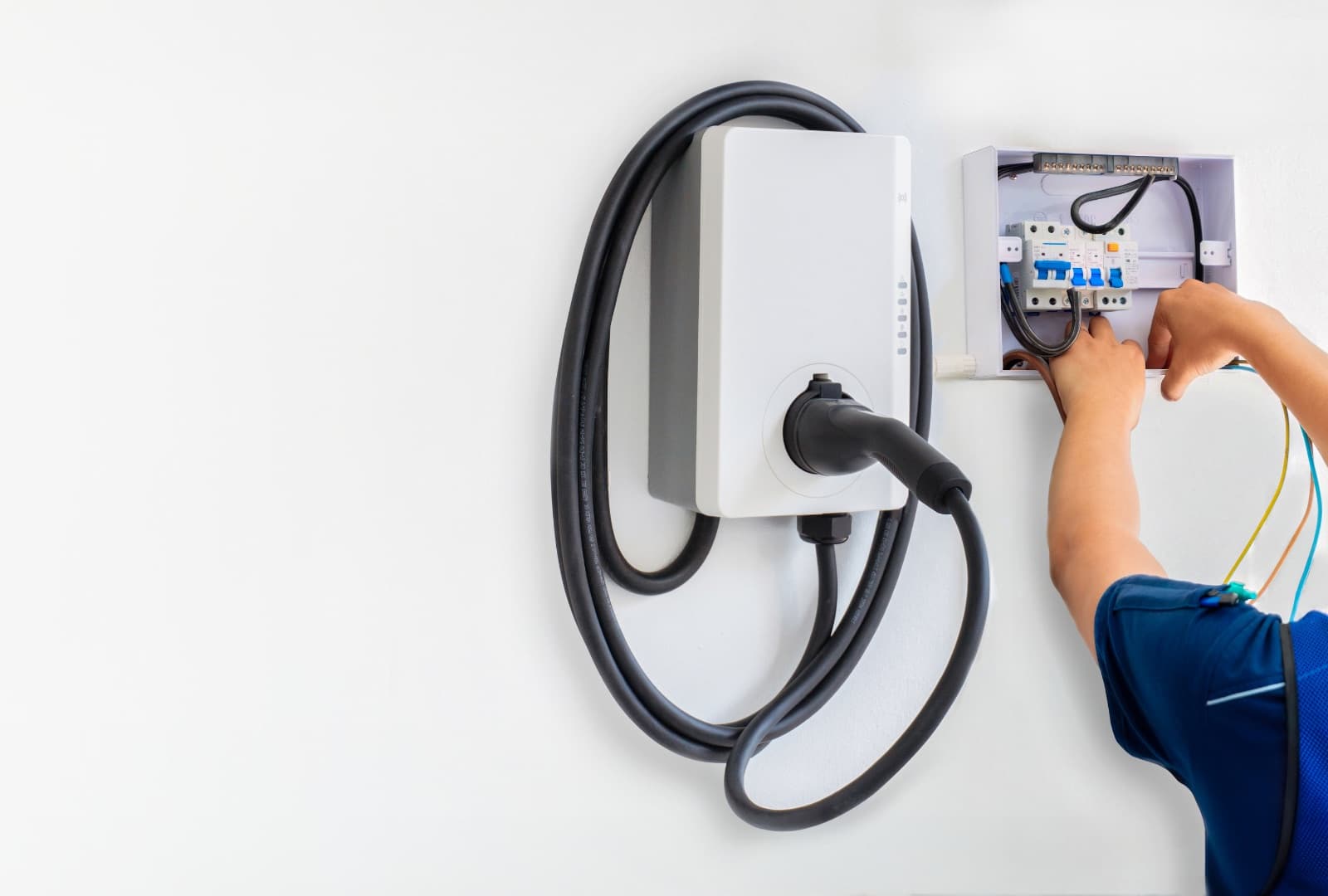
Charging an electric vehicle at home is mostly about one decision that happens before any hardware goes on the wall: can the house's electrical service carry a Level 2 charger, and if it is tight, what is the right way to make room? There are three common answers. Sometimes the panel simply has room for a new circuit. Sometimes load management lets the existing service handle the charger safely. Sometimes the panel or the service itself needs an upgrade. A proper load calculation tells you which one applies to your house.
Why a Level 2 charger is a different kind of load
A Level 2 charger runs on a dedicated 240-volt circuit, commonly 40, 50 or 60 amps depending on the charger and the vehicle. What makes it different from most household loads is how long it runs. A dryer or an oven runs hard for a while and then cycles off. An EV charger can run at its full rated output for hours, often overnight, which is why the electrical code treats it as a continuous load and sizes the circuit with extra margin.
The U.S. Department of Energy's guide to charging at home puts the starting point plainly. It says electricians can tell homeowners whether their home has adequate electrical capacity for vehicle charging, that a qualified electrician can add circuits to accommodate the capacity Level 2 charging needs, and that permits may be required from local building authorities.
Step one is the load calculation
Before recommending anything, we calculate what the house actually demands: the air conditioning, the water heater, the range, the dryer, a pool pump or a well pump, and everything else that could be running on a hot evening when the car is plugged in. The calculation is not optional. Trade publication EC&M's summary of how the 2023 National Electrical Code affects the electrified home states that a load calculation must be performed to determine the adequate capacity of the system.
The result lands in one of three places.
Outcome one, the panel has room
If the calculation shows comfortable headroom on the existing service and there is space in the panel, the job is a new dedicated circuit, the right wire and breaker for the charger, and a proper termination at the charger or receptacle. This is the simplest outcome, and our EV charger installation page explains how we handle it from site visit to first charge.
Outcome two, load management makes room
If the service is close to its limit but not over it, an energy management device can be the smarter answer. It monitors the house's demand and reduces or pauses the charger when other large loads are running, then lets it charge at full speed again when demand drops. The car still charges overnight, and the house never asks more of the service than it can deliver.
The code recognizes this approach. The same EC&M article notes that one branch circuit may supply multiple EV chargers when the loads are managed by an energy management system. Our load management page explains how these systems work, including on homes with a standby generator.
Outcome three, upgrade the panel or the service
If the house is already near capacity, or the panel is full, outdated or one of the brands with a poor record, the right answer is a panel or service upgrade. That involves the utility, because the meter and service drop belong to them. Oncor, for example, notes on its electric vehicles page that an EV project may mean increased electric usage and that it can help customers understand whether their location will need an upgrade. We coordinate that conversation with whichever utility serves your address.
An upgrade is the bigger project, but it also clears the way for whatever comes next, whether that is a second vehicle, a heat pump or a backup power system.
If you also have, or want, a standby generator
An EV charger and a generator need to be designed with each other in mind. A charger drawing full power during an outage could consume a large share of the generator's capacity at exactly the wrong time. In most backup designs, we put the charger on a managed circuit that stays offline while the generator is running, so the house gets priority. If a standby generator installation is on your list too, planning both at once avoids paying for the same panel work twice.
Choosing the charger itself
Once the electrical side is settled, the charger is the easy part. Look for a unit that is listed for safety and, if efficiency matters to you, ENERGY STAR certified. ENERGY STAR states on its EV charger page that certified chargers use 40% less energy in standby mode, which adds up because a charger spends much of its life plugged in but not charging.
Talk to Armored Power Systems
Buying an EV, or already have one and want to charge at home? We will run the load calculation and tell you which of the three outcomes fits your house before you buy anything.
Call (817) 381-6158 or email info@armoredpowersystems.com.