
Service area
Home Standby Generators for Cresson, TX
A town of about 1,349 people sitting where three counties meet, at the end of long rural feeders. We have been called out to properties here that had been living on a portable generator for the better part of a week.
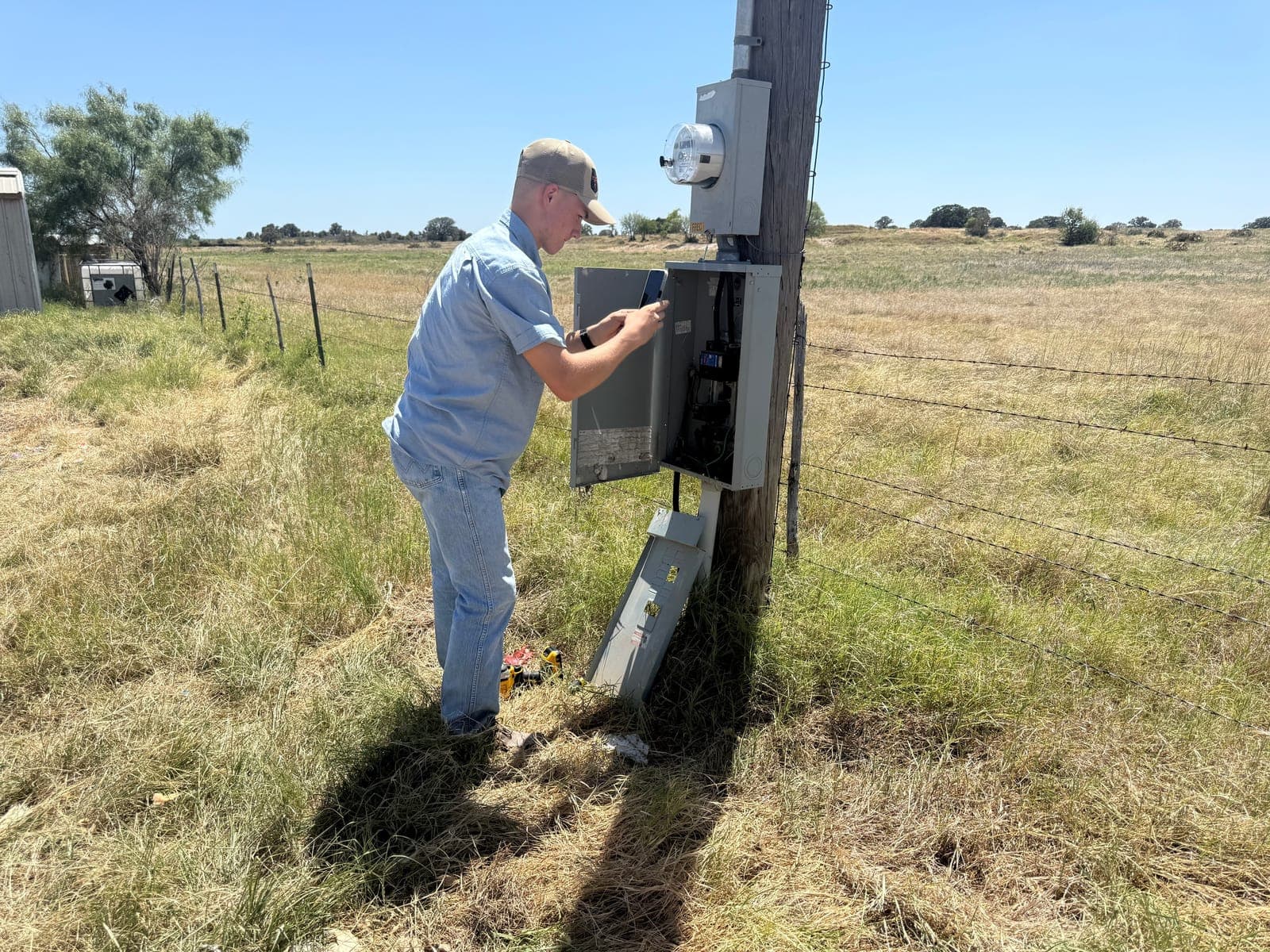
The town
Three counties meet inside the city limits
Cresson sits at the intersection of US Highway 377 and State Highway 171, seventeen miles south-west of Fort Worth, on the tripoint where Hood, Johnson and Parker counties meet. The 2020 census counted 1,349 people. The city limits reach into all three counties, so neighbours a few streets apart can answer to different county authorities and feed into different school districts.
That is a genuine complication rather than a piece of trivia. County lines decide permitting, on-site sewage authorization and, out here, which member-owned cooperative owns the wire. United Cooperative Services runs from Cleburne across Johnson, Bosque, Hood and Tarrant counties with more than 54,000 members; Tri-County Electric Cooperative, headquartered in Azle, carries much of the Parker County line. Establishing which one serves a specific meter is the first thing we do, not the last.
The reason this page exists, though, is simpler than any of that. Long feeders, few customers per mile and a lot of conductor exposed to wind make for outages measured in days. That is the condition a standby system is actually for.
What long outages change
Design for days, not for hours
Almost every decision in a rural system flows from one number: how long you expect to be running on it.
The tank, not the machine
On a property without a gas main, propane is the working assumption, and a tank sized against a brochure runtime figure is the most common expensive mistake out here. We size the fuel system to the real load and a realistic number of days — see propane versus natural gas and how long a standby generator can run.
The pump has to start
A submersible pump starts against full head pressure with no unloading valve and no gentle spin-up, which makes it one of the hardest loads on the property. On a well, no power is no water — at the tap and at the trough. See well pump backup.
The pad is sited around the drainfield
On septic, the drainfield is frequently the biggest single constraint on where a generator is allowed to sit, and it is not always where the homeowner believes it is. That gets established during the site walk, along with the run back to the panel.
Nobody has to be home
A standby system starts on its own, usually within seconds, and an automatic transfer switch isolates the utility before it does. That is the difference between backup power and a machine somebody has to wake up to refuel at three in the morning.
The honest comparison
A portable is a four-hour answer to a five-day problem
Plenty of properties around here already own one. It is worth being precise about what it does and does not cover.
Refuelling is a night shift
Somebody has to be awake, at home and holding fuel. Across five days that is not a contingency plan, it is a rota — and the fuel usually has to come from a station that is also out of power.
It will not start the pump
Starting current on a submersible pump or an air-conditioning compressor is several times its running load. Most portables cannot deliver it, which is why the water and the cooling are the two things they do not cover.
Cords are not a wiring method
Extension cords through a window carry loads they were never designed for, and back-feeding a panel is dangerous to you and to the crew on the line. A transfer switch exists to make that impossible.
What we do here
Rural systems, designed for the outage you actually get
Standby Generator Installation
County permitting on the right side of three lines, pad clear of the drainfield, fuel sized for days.
See detailsGenerator Sizing
The well pump, the septic lift, the shop and the compressors — measured, not estimated.
See detailsLoad Management
Rotate the large loads and a smaller machine covers the property, usually for less money.
See detailsCommercial Generators
Ranch, barn, shop and small-facility power where an outage costs stock or livestock.
See detailsWhole-Home Surge Protection
Rural feeders and reclosers put more transients on a line than lightning ever does.
See detailsGenerator Repair
Generac, Kohler, Briggs & Stratton, Cummins, Champion and Honeywell, including units we did not install.
See details
Nearby
North and west from here
Cresson is the southern edge of the map. Everything else on this list is between it and the shop.
- Aledo, TXStraight north, and the closest of our regular territory.
- Weatherford, TXNorth-west, a city-owned electric utility and the largest share of our work.
- Stephenville, TXWest into Erath County, the most electricity-dependent county we serve.
- Parker County, TXThe county the northern edge of town sits in.
Common questions
Cresson generator questions
County lines, co-op territory, why the outages run long, and whether a portable is enough.
Why is Cresson on your list when it is not one of your counties?
Because of the outages rather than the population. Cresson is a town of about 1,349 people at the intersection of US 377 and SH 171, seventeen miles south-west of Fort Worth, and it sits at the end of long rural feeders on member-owned co-op line. We have walked onto properties there that had been running off a portable generator, refuelled by hand, for the better part of a week. That is the exact problem a standby system exists to solve, and it is a comfortable drive from Aledo and Weatherford where a good deal of our work already is.
Which county am I in, and which co-op serves me?
It genuinely varies street by street. Cresson sits on the tripoint where Hood, Johnson and Parker counties meet, and the city limits reach into all three — neighbours a few streets apart can be in different counties and different school districts. Co-op territory follows the county and feeder geography rather than the town limits: United Cooperative Services, headquartered in Cleburne, serves more than 54,000 members across Johnson, Bosque, Hood and Tarrant counties, while Tri-County Electric Cooperative carries much of the Parker County line. We confirm which one owns your meter at the site visit, because it decides who you report an outage to and how the restoration queue treats you.
Why do rural outages here last so long?
Feeder geometry, mostly. A rural circuit runs more line miles per customer, with more conductor exposed to trees and wind, and crews work the largest outages first — which is almost never the county road. That is not a criticism of the co-op; it is arithmetic. The practical consequence is that the runtime you plan for out here is measured in days rather than hours, and that pushes the fuel decision, and the tank size, to the front of the design instead of the back.
Is there natural gas?
Out here, generally not. Propane is the working assumption on rural property around Cresson, and it is the single decision with the largest effect on whether the system actually carries you through a long outage. A tank sized to a brochure figure runs out; a tank sized to your real load and a realistic number of days does not. We size the fuel system as part of the design rather than leaving it to whoever sets the tank.
I am on a well and a septic system. What changes?
Almost everything. No power means no water at the tap and none for livestock, a septic lift pump that stops moving, and a gate that has to be cranked by hand. A submersible pump also starts under full head pressure with no gentle spin-up, which makes it one of the hardest loads on the property to start and often the load that sets the size of the machine. The pad also has to be sited clear of the drainfield, which on an acreage property is a real constraint rather than a formality.
Is a portable generator not enough?
It will keep a refrigerator and some lights going, and for a four-hour outage that is a reasonable answer. Across five days it is a different proposition: someone has to be awake to refuel it, it will not start a submersible pump or a compressor, extension cords are doing work they were not designed for, and the exhaust has to stay a long way from the house. A standby system starts on its own, usually within seconds, runs on the fuel already on the property, and does not require anybody to be home.
Related
Keep reading
- Do I Need a Generator for a Well Pump?On a private well, an outage is a water outage. This is the arithmetic.
- How Long Can a Standby Generator Run?Runtime, fuel consumption and the service interval a long outage forces.
- Propane vs Natural Gas GeneratorsThe decision that matters most on a property with no gas main.
- Texas Power Outage PreparednessWhat to have in place before the next multi-day event.
- Generator SizingStarting current, load management and why square footage decides nothing.
- Financing OptionsIndependent lenders, applied for directly, subject to credit approval.
Two ways to start
Which one are you?
Need a generator
We start with what has to keep running at your property — the well, the AC, the freezer, the shop — and size the system around it. You get a written proposal with the equipment, the electrical work and the site prep all in one number.
Already own one
Repair, diagnostics and scheduled maintenance for Generac, Kohler and Briggs & Stratton systems — including units another company installed. Tell us the brand and what it is doing and we will bring the right parts.