
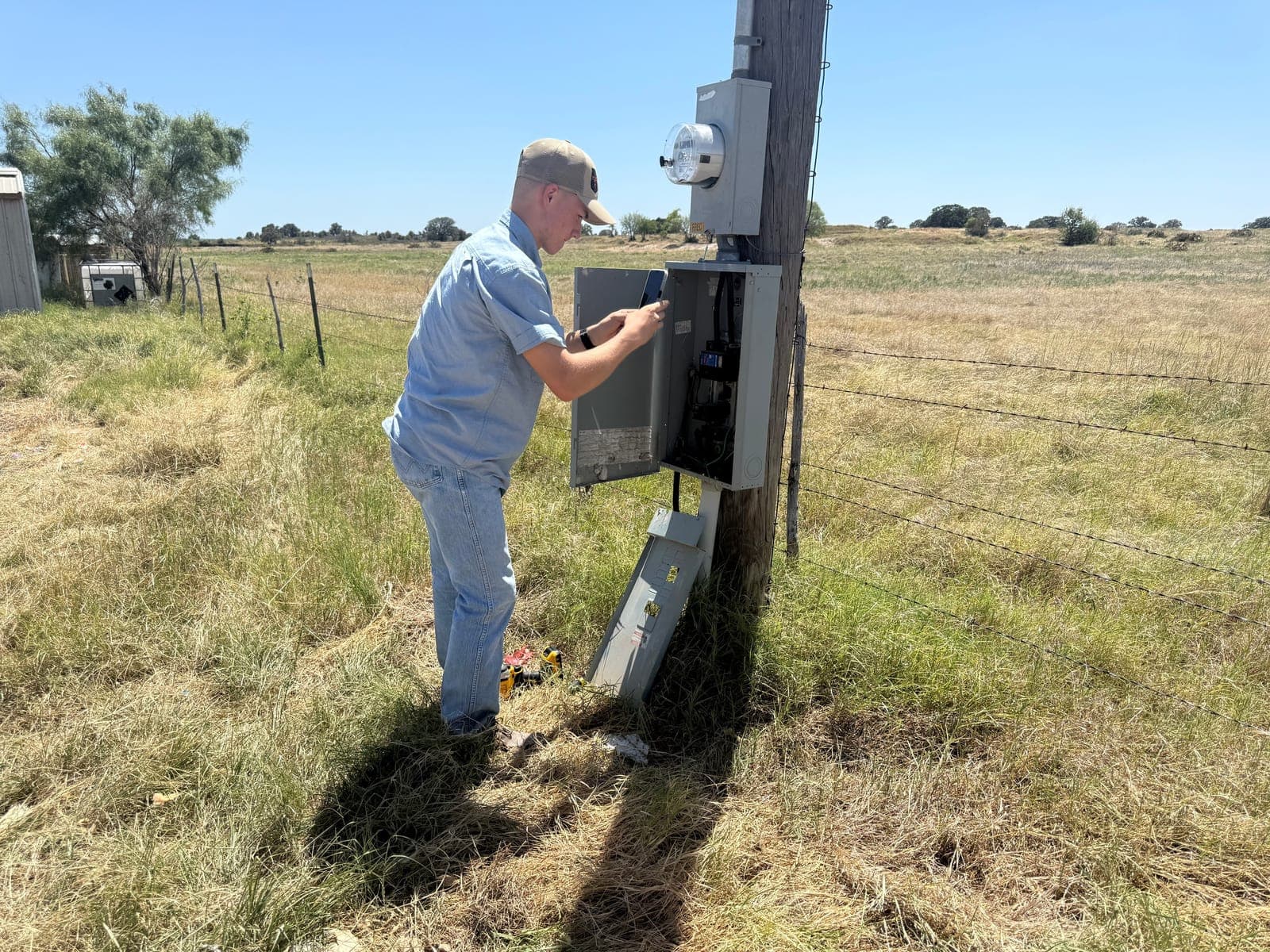
If your house has a few decades behind it, the electrical panel in the garage or utility room may be one of the oldest working parts of the home. Two brand names come up again and again when electricians open those panels: Federal Pacific Electric, whose breakers carry the Stab-Lok name, and Zinsco, which was also sold as Zinsco-Sylvania. Neither has gone into new homes for a long time, but plenty are still in service across Texas.
They matter most at the moment a homeowner wants to add something large, like a standby generator, a Level 2 EV charger or a solar and battery system. This post covers how to recognize these panels, what is and is not actually documented about them, and what a sensible next step looks like.
How to tell which panel you have
You can usually identify the brand without touching anything electrical. Open the panel door, but leave the inner cover (the dead front) in place. Removing that cover exposes live parts and is a job for a licensed electrician.
Then look for the manufacturer's name in three places:
- The label on the inside of the panel door, which usually names the manufacturer and lists the panel's ratings.
- The breakers themselves. Federal Pacific breakers are typically marked Stab-Lok, and the label may read Federal Pacific Electric or FPE.
- For Zinsco, the label may read Zinsco, Zinsco-Sylvania or simply Sylvania.
If the label is missing, painted over or unreadable, do not guess. Take a clear photo of the open door and the breakers and send it to a licensed electrician who can identify the equipment.
What is documented about Federal Pacific breakers
The U.S. Consumer Product Safety Commission investigated Federal Pacific Stab-Lok circuit breakers and closed that investigation in 1983. Its notice on the closed investigation states that the data available to it did not establish that the breakers pose a serious risk of injury, and that the closure was not a determination about their safety either way. The Commission also noted that it can reopen the investigation if further information warrants.
In plain terms, there has been no formal government finding in either direction, which is why the subject is still debated. The concern that engineers and home inspectors keep raising is that some of these breakers may not trip when they should. A breaker has one job, which is to open the circuit during an overload or short circuit, and doubt about that job is a reasonable thing to resolve.
The same CPSC notice gives advice that applies to any panel. If a breaker or fuse keeps tripping, do not simply reset it or replace the fuse, and when in doubt, consult a licensed electrician.
What is documented about Zinsco panels
Zinsco and Zinsco-Sylvania panels have never been the subject of a product recall. The concerns come from the people who work on them. InspectAPedia, an independent building-inspection reference that collects the technical literature on this equipment, concludes that there is little doubt the equipment is a fire and injury hazard. That is an expert opinion rather than a regulatory ruling, but it reflects how the trade generally treats these panels when they turn up.
Warning signs worth acting on in any older panel
Brand aside, age alone is a reason to have a panel looked at. The Electrical Safety Foundation International, in its home wiring safety tips, recommends an electrical inspection for homes 40 or more years old. It also warns specifically about panels with fuses or breakers rated higher than the capacity of the circuits they protect, which is a common result of years of do-it-yourself changes.
Other signs we take seriously during an assessment include:
- Breakers that trip repeatedly, or that you have learned to work around.
- Lights that dim when the air conditioning starts.
- Warmth, discoloration, scorch marks or a burning smell at the panel.
- No spare slots, or breakers doubled up to make room.
None of these proves the panel is failing, but each one is worth a professional look before more load is added.
Why it matters before a generator, EV charger or solar
Most of the equipment homeowners add today is large and long-running. A standby generator ties into the service through a transfer switch. A Level 2 EV charger is a continuous load that can run at full output for hours. Solar and battery systems need a panel that can safely accept power coming back in from the inverter.
That is why we assess the panel and the service before we quote standby generator installation or EV charger installation. When we find a Federal Pacific or Zinsco panel, we treat it as something to resolve before new equipment is tied in, not after. It is far better to know that at the estimate than to discover it on installation day.
A panel replacement is also the natural moment to add whole-home surge protection, since the work is already happening at the panel.
What to do next
- Identify the panel. Open the door, read the label and the breakers, and take a photo.
- Hire a licensed electrical contractor. In Texas, electrical work must be performed through a licensed electrical contractor, and you can check any contractor's license on the Texas Department of Licensing and Regulation search.
- Ask for a panel assessment and a load calculation, not just a quote for a new box. The calculation tells you whether a replacement panel is enough or whether the service itself needs to be upgraded.
- Get the scope in writing, including the permit, the inspection and how the utility disconnect and reconnect will be handled.
- Plan the order of work. If a generator, EV charger or solar system is on your list, settle the panel first so everything that follows ties into equipment you trust.
Our electrical panel upgrade and replacement page explains how we handle that process from assessment to final inspection.
Talk to Armored Power Systems
Not sure what is behind your panel door? Send us a photo or book a panel assessment and we will tell you exactly what you have and what it would take to make it ready for what you want to add.
Call (817) 381-6158 or email info@armoredpowersystems.com.